
Development of ARGEONET integrated with metaverse and M6 learning model to enhance students’ mathematical critical thinking skills
##plugins.themes.bootstrap3.article.sidebar##
##plugins.themes.bootstrap3.article.main##
Abstract
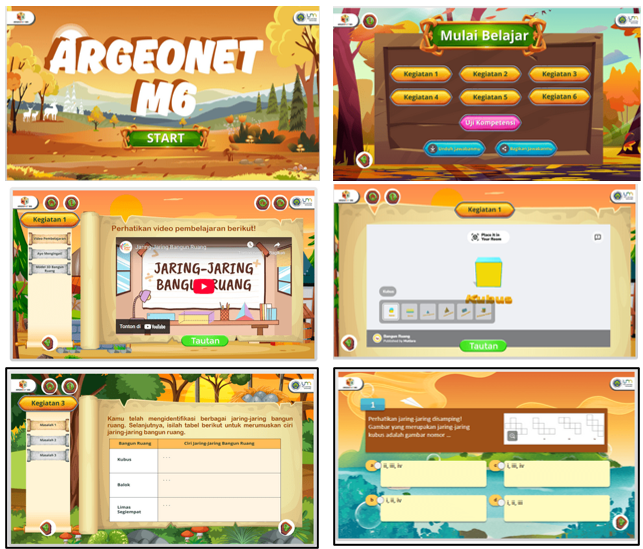
Critical thinking is an essential 21st-century competency. Many junior high school students still demonstrate low levels of mathematical critical thinking. This study aims to develop ARGEONET, an integrated augmented reality media resource that supports the MathVerse M6 learning model and is designed to improve students' critical thinking skills in mathematics. The research employed a Research and Development (Plomp's educational design framework). The participants were 30 junior high school students in Banyuwangi Regency, East Java, Indonesia, selected through purposive sampling. Data were collected using expert validation sheets, observation sheets, student response questionnaires, and mathematical critical-thinking tests. The results show that ARGEONET obtained very high validity, with scores of 89% and 93% from validators, and was classified as very practical, with scores of 86.06% from students and 91.43% from teachers. Effectiveness analysis showed significant differences in five critical thinking indicators: focus (sig. 0.004), reason (sig. 0.001), inference (sig. 0.003), situation (sig. 0.050), clarity (sig. 0.481), and overview (sig. 0.042). The effect size from each indicator, namely small (clarity), medium (situation and overview), and large (focus, reason, inference). ARGEONET shows potential as an augmented reality media to enhance students' critical thinking skills.
##plugins.themes.bootstrap3.article.details##

This work is licensed under a Creative Commons Attribution-ShareAlike 4.0 International License.
The author is responsible for acquiring the permission(s) to reproduce any copyrighted figures, tables, data, or text that are being used in the submitted paper. Authors should note that text quotations of more than 250 words from a published or copyrighted work will require grant of permission from the original publisher to reprint. The written permission letter(s) must be submitted together with the manuscript.References
Al Hajri, M., Bani Orabah, S., Domalaon, D., & Bijani, H. (2025). Evaluating the quality of blended learning in higher education: Teachers’ and students’ perceptions in an Omani EFL context. Arab World English Journal, 11, 20–42. https://doi.org/10.24093/awej/call11.2
Al Khateeb, A., & Alotaibi, H. (2024). The upsurge of the metaverse in educational settings: a meta-analysis study. Pegem Journal of Education and Instruction, 14(3), 62–75.
Alruthaya, A., Nguyen, T.-T., & Lokuge, S. (2021). The application of digital technology and the learning characteristics of Generation Z in higher education Australasian Conference on Information Systems, Sidney.
Aslan, S., & Aybek, B. (2024). Development of critical-thinking skills rubric within the scope of multicultural education. Educational Process International Journal, 13(3), 139–158. https://doi.org/10.22521/edupij.2024.133.8
Avci, Ü., & AkgÜL, F. (2024). The effect of metaverse technologies on education and human-computer interaction: A systematic analysis of the literature. Journal of Educational Technology and Online Learning, 7(1), 1–16. https://doi.org/10.31681/jetol.1302048
Avcu, Y. E., & Yaman, Y. (2024). Differentiated science instruction in the metaverse with gifted students: Let’s visit Kaz Mountains national park! Journal of Inquiry Based Activities, 14(2), 46–65.
Chang, H.-Y., Binali, T., Liang, J.-C., Chiou, G.-L., Cheng, K.-H., Lee, S. W.-Y., & Tsai, C.-C. (2022). Ten years of augmented reality in education: A meta-analysis of (quasi-) experimental studies to investigate the impact. Computers & Education, 191, 104641. https://doi.org/10.1016/j.compedu.2022.104641
Cheerapakorn, P., Hinon, K., & Wannapiroon, P. (2024). Hybrid project-based learning model on metaverse to enhance collaboration. International Education Studies, 17(6), 65–78. https://doi.org/10.5539/ies.v17n6p65
Chen, S.-J., Chen, C.-Q., & Shan, X.-F. (2024). The effects of an immersive virtual-reality-based 3D modeling approach on the creativity and problem-solving tendency of elementary school students. Sustainability, 16(10), 4092. https://doi.org/10.3390/su16104092
Cohen, J. (1992). A power primer. Psychological bulletin, 112(1), 155–159. https://doi.org/10.1037/0033-2909.112.1.155
Demircioglu, T., Karakus, M., & Ucar, S. (2023). Developing students’ critical thinking skills and argumentation abilities through augmented reality–based argumentation activities in science classes. Science & Education, 32(4), 1165–1195. https://doi.org/10.1007/s11191-022-00369-5
Dignath, C., van Ewijk, R., Perels, F., & Fabriz, S. (2023). Let learners monitor the learning content and their learning behavior! A meta-analysis on the effectiveness of tools to foster monitoring. Educational Psychology Review, 35(2), 62. https://doi.org/10.1007/s10648-023-09718-4
Djamas, D., Tinedi, V., & Yohandri, Y. (2018). Development of interactive multimedia learning materials for improving critical thinking skills. International Journal of Information and Communication Technology Education, 14(4), 66–84. https://doi.org/10.4018/ijicte.2018100105
Egan, L., Tang, J. H., Ferraro, D., Erberber, E., Tsokodayi, Y., Stearns, P., & Malley, L. (2022). US technical report and user guide for the 2019 trends in international mathematics and science study (TIMSS). Part 1. NCES 2022-049. National Center for Education Statistics. https://files.eric.ed.gov/fulltext/ED623028.pdf
Ennis, R. H. (1996). Critical thinking. Prentice-Hall Inc.
Eşin, Ş., & Özdemir, E. (2022). The metaverse in mathematics education: The opinions of secondary school mathematics teachers. Journal of Educational Technology and Online Learning, 5(4), 1041–1060. https://doi.org/10.31681/jetol.1149802
Facione, P. A., Sanchez, C. A., Facione, N. C., & Gainen, J. (1995). The disposition toward critical thinking. The Journal of general education, 44(1), 1–25. https://www.jstor.org/stable/27797240
Groenwold, R. H. H., Shofty, I., Miočević, M., van Smeden, M., & Klugkist, I. (2018). Adjustment for unmeasured confounding through informative priors for the confounder-outcome relation. BMC Medical Research Methodology, 18(1), 174. https://doi.org/10.1186/s12874-018-0634-3
Hazaymeh, W. A., & Alomery, M. K. (2021). The effectiveness of visual mind mapping strategy for improving english language learners' critical thinking skills and reading ability. European Journal of Educational Research, 11(1), 141–150. https://doi.org/10.12973/eu-jer.11.1.141
Huang, H.-M. (2024). Effectiveness of simulation-based augmented reality in enhancing pediatric nursing and clinical reasoning competency among students: A quasi-experimental study. Clinical Simulation in Nursing, 95, 101601. https://doi.org/10.1016/j.ecns.2024.101601
Hyytinen, H., Nissinen, K., Kleemola, K., Ursin, J., & Toom, A. (2023). How do self-regulation and effort in test-taking contribute to undergraduate students’ critical thinking performance? Studies in Higher Education, 49(1), 192–205. https://doi.org/10.1080/03075079.2023.2227207
Kemendikbud. (2022). Panduan pembelajaran dan asesmen di sekolah menengah pertama [Learning and assessment guide in junior high school]. Kementerian Pendidikan, Kebudayaan, Riset, dan Teknologi Republik Indonesia.
Khusna, A. H., Siswono, T. Y. E., & Wijayanti, P. (2024). Mathematical problem design to explore students' critical thinking skills in collaborative problem solving. Mathematics Teaching Research Journal, 16(3), 217–240.
Kishore, K., Jaswal, V., Kulkarni, V., & De, D. (2021). Practical guidelines to develop and evaluate a questionnaire. Indian Dermatology Online Journal, 12(2), 266–275. https://doi.org/10.4103/idoj.IDOJ_674_20
Kongkhen, P., & Chatwattana, P. (2023). The project-based learning: PjBL via brainstorming with metaverse to promote multimedia production skills. Higher Education Studies, 13(4), 193–200. https://doi.org/10.5539/hes.v13n4p193
Koo, T. K., & Li, M. Y. (2016). A guideline of selecting and reporting intraclass correlation coefficients for reliability research. Journal of Chiropractic Medicine, 15(2), 155–163. https://doi.org/10.1016/j.jcm.2016.02.012
Lin, Y., & Yu, Z. (2023). Extending technology acceptance model to higher-education students’ use of digital academic reading tools on computers. International Journal of Educational Technology in Higher Education, 20(1), 34. https://doi.org/10.1186/s41239-023-00403-8
Ma, J., Jin, Y., Zhao, D., & Chen, L. (2023). The research on the application of educational metaverse in the experimental teaching of medical physiology. International Journal of Technology in Teaching and Learning, 19(1), 69–85. https://doi.org/10.37120/ijttl.2023.19.1.04
Mahdi, H. S., & Sahari, Y. M. (2024). Exploring the relationship between critical thinking, attitude, and anxiety in shaping the adoption of artificial intelligence in translation among Saudi translators. Journal of Pedagogical Research, 8(2), 81–94. https://doi.org/10.33902/jpr.202423345
Mandala, A. S., Anwar, L., Sa'dijah, C., & Zulnaidi, H. (2025). Development of mobile augmented reality-based geometry learning games to facilitate spatial reasoning. Infinity Journal, 14(2), 323–348. https://doi.org/10.22460/infinity.v14i2.p323-348
Maulida, A. S., Wahyudin, W., Turmudi, T., & Nurlaelah, E. (2024). The effect of experiential learning and directed instructions assisted by augmented reality on students' self-regulated learning. Infinity Journal, 13(2), 553–568. https://doi.org/10.22460/infinity.v13i2.p553-568
Molle, J. S., & Sabandar, V. P. (2025). Developing the reasoning ability of students through three-dimensional figures learning The 2nd International Conference on Mathematics and Mathematics Education (ICMMeD) 2023,
Mutchima, P., Leelakitpaisarn, Y., Pijitkamnerd, B., Phiwma, N., & Pantrakool, S. (2025). The effect of metaverse technology on multicultural learning: Strengthening the social attitudes, cultural awareness and critical thinking skills of secondary school students. Journal of Education and e-Learning Research, 12(1), 21–30. https://doi.org/10.20448/jeelr.v12i1.6329
Nieveen, N., & Folmer, E. (2013). Formative Evaluation in Educational Design Research. In T. Plomp & N. Nieveen (Eds.), Educational design research (pp. 152–169). Netherlands Institute for Curriculum Development (SLO).
Nosrat, A., & Parsafar, A. (2018). Effect of problem-solving based methods on critical thinking and academic achievement of math among students of saravan higher education centers. International Journal of Applied Mathematical Research, 7(1), 1–6. https://doi.org/10.14419/ijamr.v7i1.8397
O'Connor, Y., & Mahony, C. (2023). Exploring the impact of augmented reality on student academic self-efficacy in higher education. Computers in human Behavior, 149, 107963. https://doi.org/10.1016/j.chb.2023.107963
OECD. (2023). PISA 2022 results (volume I): The state of learning and equity in education. OECD Publishing. https://doi.org/10.1787/53f23881-en
Pereles, A., Ortega-Ruipérez, B., & Lázaro, M. (2024). The power of metacognitive strategies to enhance critical thinking in online learning. Journal of Technology and Science Education, 14(3), 831–843. https://doi.org/10.3926/jotse.2721
Plomp, T. (2013). Educational design research: An introduction. In T. Plomp & N. Nieveen (Eds.), Educational design research (pp. 10–51). Netherlands Institute for Curriculum Development (SLO).
Rachmadtullah, R., Setiawan, B., Wasesa, A. J. A., Wicaksono, J. W., & Rasmitadila, R. (2023). The utilization of metaverse technology applications based on science, technology, engineering and mathematics (Meta-STEM) to improve critical thinking skills. Journal of Education and e-Learning Research, 10(4), 778–784. https://doi.org/10.20448/jeelr.v10i4.5203
Rassyi, S. F. R., Supriadi, S., Andayani, Y., Hakim, A., Burhanuddin, B., & Hadisaputra, S. (2023). Development of the interactive learning media based on augmented reality 3D on the petroleum concept. IJCER (International Journal of Chemistry Education Research), 7(1), 44–51. https://doi.org/10.20885/ijcer.vol7.iss1.art8
Riduwan, R. (2022). Skala pengukuran variabel-variabel penelitian [Measurement scale of research variables]. Alfabeta.
Rohendi, D., & Wihardi, Y. (2020). Learning three-dimensional shapes in geometry using mobile-based augmented reality. International Journal of Interactive Mobile Technologies (iJIM), 14(9), 48–60. https://doi.org/10.3991/ijim.v14i09.13035
Suh, W., & Ahn, S. (2022). Utilizing the metaverse for learner-centered constructivist education in the post-pandemic era: An analysis of elementary school students. Journal of Intelligence, 10(1), 17. https://doi.org/10.3390/jintelligence10010017
Susandi, A. D., Sa’dijah, C., As’ari, A. R., & Susiswo, S. (2022). Developing the M6 learning model to improve mathematic critical thinking skills. Pedagogika, 145(1), 182–204. https://doi.org/10.15823/p.2022.145.11
Talan, T., & Kalinkara, Y. (2022). Students' opinions about the educational use of the metaverse. International Journal of Technology in Education and Science, 6(2), 333–346. https://doi.org/10.46328/ijtes.385
Tarng, W., Huang, J.-K., & Ou, K.-L. (2024). Improving elementary students’ geometric understanding through augmented reality and its performance evaluation. Systems, 12(11), 493. https://doi.org/10.3390/systems12110493
Tural, A., & Koçak, N. (2023). Awareness levels of social studies pre-service teachers regarding metaverse use. Advanced Education, 11(23), 69–86. https://doi.org/10.20535/2410-8286.284683
Wang, Q., & Abdullah, A. H. (2024). Enhancing students’ critical thinking through mathematics in higher education: A systemic review. SAGE Open, 14(3), 1–15. https://doi.org/10.1177/21582440241275651
Whitney-Smith, R. M. (2023). The emergence of computational thinking in national mathematics curricula: An Australian example. Journal of Pedagogical Research, 7(2), 41–55. https://doi.org/10.33902/jpr.202318520
Wijaya, T. T., Hidayat, W., Hermita, N., Alim, J. A., & Talib, C. A. (2024). Exploring contributing factors to PISA 2022 mathematics achievement: Insights from Indonesian teachers. Infinity Journal, 13(1), 139–156. https://doi.org/10.22460/infinity.v13i1.p139-156